Wednesday, March 18, 2026
VAT and Sales Tax Compliance for Audio Plugin Companies: A Complete Guide

Hampus Åström
Moonbase Founder
Hampus is financial founder of Moonbase, making sure we are working safely as a merchant of record all around the world.
This article is for informational purposes only and does not constitute legal or tax advice. Consult a qualified tax professional for your specific situation.
If you're running an audio software company—whether you're selling VST plugins, AU plugins, virtual instruments, or sample libraries, chances are you're not fully tax compliant. And you're not alone. Most plugin developers using Shopify, WooCommerce, or similar e-commerce platforms are potentially not compliant with VAT and sales tax obligations.
The reality is that most online businesses and audio software companies have operated without full tax compliance because tax authorities lacked the systems to track digital sales effectively. But that's changing fast. Payment processors have been reporting seller data to tax authorities since January 2024, and the window for operating under the radar is closing. More importantly, every month you wait, your potential back-tax debt grows larger.
The Basic Problem: Destination-Based Taxation for Digital Products
Here's what most audio software companies don't realize: when you sell a VST plugin to a customer in Germany, France, or Norway, you're supposed to charge that country's VAT or sales tax. Not the rate where your company is based, but where your customer lives. This is called destination-based taxation, and it's the law in most developed countries.
Let's say you sell a $99 virtual instrument to a customer in Germany. You should be charging 19% German VAT ($18.81), registering with German tax authorities (or using the EU's One-Stop Shop system to handle multiple EU countries through a single registration), filing periodic returns, and keeping detailed records for potential audits. In Germany, tax authorities can assess back taxes up to 4 years (or 10 years in cases of deliberate evasion). The EU's One-Stop Shop simplifies VAT for EU sales by letting you register once and file in one place, but you still need to calculate correct rates for each country, file quarterly returns, and handle non-EU countries like the UK, Norway, and Switzerland separately. The same principle applies to the UK (20% VAT), Norway (25% VAT), Switzerland (8.1% VAT), Canada (5-15% GST/HST depending on province), and dozens of other countries.
Different countries have different tax rates, different registration thresholds, different filing frequencies, and different documentation requirements. Norway requires foreign businesses to register after their sales exceed NOK 50,000 (roughly $4,600) in any 12-month period. Switzerland has a global threshold of CHF 100,000 (approximately $113,000), but with a catch: if you make even a single B2C sale in Switzerland, all your sales there become taxable. Canada requires registration once you exceed CAD 30,000 (around $21,500) in consumer sales over any 12-month period.
This isn't about physical presence. You don't need an office in Germany or a subsidiary in Switzerland to owe these taxes. The moment a UK or Swiss consumer clicks "buy" on your website, you've triggered a tax obligation in that country.
Why the Landscape Is Changing (And Why It Matters Now)
For years, online businesses and audio software companies flew under the radar because tax authorities had no practical way to track cross-border digital sales.
In the EU, the DAC7 directive went into effect on January 1, 2023, with the first reporting deadline hitting on January 31, 2024. Payment processors submitted their second annual DAC7 report in January 2025, and the third report was filed in January 2026. DAC7 requires digital platforms—including payment processors like Stripe and PayPal—to collect detailed information about sellers and automatically report it to EU tax authorities. This information includes seller identities, transaction totals, and customer locations. Once filed in one EU country, this data is shared across all member states through an automatic exchange system.
This means if you're processing payments through Stripe (whether directly or through platforms like Shopify that use Stripe under the hood) for EU sales, the tax authorities in every EU country now have visibility into your revenue streams. They know who you are, where your customers are, and how much you're selling. Tax authorities now have three years of seller data from DAC7 reports. What they do with it remains to be seen, but the infrastructure for cross-border enforcement is in place, something that didn't exist before 2024. This means if you sell €10,000 worth of plugins to German customers, Germany's tax authority knows about it, even if you've never registered there. Whether and when they act on this information is unclear, but the visibility that didn't exist before 2024 now does.
Similar frameworks are being implemented globally. The UK has its own version called Digital Reporting Rules. Other jurisdictions are following suit with their own reporting mandates. The infrastructure for enforcement now exists. It just hasn't been fully deployed yet.
Here's why timing matters: Every month you operate without proper tax compliance, you're accumulating potential back-tax debt. If you're doing $100K/year with 30% EU sales, that's roughly $6,000 per year in unpaid taxes. Wait two years? That's $12,000 plus interest. Wait five years before getting acquired or scaling significantly? You're looking at $30,000+ that needs to be paid off before any deal can close. Since we're now in March 2026 and payment processors have already submitted three annual reports to EU tax authorities, the data about your sales is already in the system.
Why Small Plugin Companies Should Care Now
"But I'm only making $50,000 a year—why would tax authorities bother with me?"
This is the most common objection, and it's worth addressing directly for companies at different stages:
If you're a hobby developer ($10-50K/year): You're right that you're probably not the tax authority's top priority today. But you're building up debt that compounds over time. More importantly, if you ever want to turn this into a real business or sell it, this debt could become an issue that needs addressing. Starting compliant from day one is significantly easier than fixing years of back taxes later.
If you're a growing business ($50-200K/year): This is the critical stage. You're past the "just a hobby" threshold but probably still handling everything yourself or with minimal outside help. Let's say you're making $100,000 annually, with 30% from EU customers and 15% from Canada/UK. That's roughly $9,000-10,000 per year in unpaid taxes. Over three years? That's $30,000+ in debt, plus interest, accumulating in the background.
If you're an established company ($200K+/year): You likely already know you have a compliance problem. The question is when to address it. The longer you wait, the more complicated it becomes to resolve. If you're considering selling within the next 2-3 years, now is the time to get compliant, before you enter serious discussions with potential buyers. Tax non-compliance is exactly the kind of issue that surfaces when buyers review your business and either kills the deal or comes out of your sale price. The best time to get compliant was when you started selling internationally; the second best time is today.
The Real Risks of Non-Compliance
Let's talk about what can actually happen if you ignore these obligations, without resorting to scare tactics.
First, there are the direct financial risks. Tax authorities can assess back taxes for past sales. In Germany, for example, they can go back 4 years (or 10 years in cases of deliberate evasion). Other countries have similar statutes, though the specific timeframes vary. In most countries, this comes with interest that compounds over time, typically ranging from 5-15% annually depending on the country. Some countries also impose administrative penalties on top of the tax owed. These vary widely by country and can range from fixed amounts to percentages of the unpaid tax.
If you ever plan to sell your audio software business, tax non-compliance becomes a problem when buyers review your business. Potential buyers will discover the issue, and they'll either walk away or dramatically reduce their offer to account for the risk. The debt doesn't disappear when ownership changes. Someone has to clean it up, and that cost comes out of the purchase price. Tax non-compliance can potentially derail a deal entirely because the tax compliance work becomes too large to calculate exactly.
There's also platform risk to consider. Payment processors and e-commerce platforms operate under increasing government oversight, and unresolved tax issues can create complications with maintaining your accounts in good standing. For an audio software company that depends on these platforms, any disruption to payment processing is a serious risk.
What Proper Compliance Actually Looks Like for Audio Software Companies
So what's the alternative?
For most audio software companies, trying to manage compliance in-house is impractical. It would require registering in dozens of countries, filing returns in multiple languages, tracking constantly changing tax rates and thresholds, keeping detailed records for potential audits, and dealing with correspondence from foreign tax authorities.
There are several approaches companies take, each with significant limitations for audio plugin developers:
DIY software solutions can calculate taxes, but you're still responsible for registrations, filings, and legal compliance across dozens of countries. You'll coordinate between your e-commerce platform, payment processor, tax software, and accountants, managing multiple systems while bearing all legal responsibility.
Tax compliance service providers handle filing and registration, but you remain the seller of record with full legal responsibility. You're still coordinating multiple vendors, and when something breaks, you're troubleshooting across all of them.
The merchant of record model takes a fundamentally different approach. A merchant of record doesn't just handle your tax compliance. They become the seller of record for your transactions. Here's how it works:
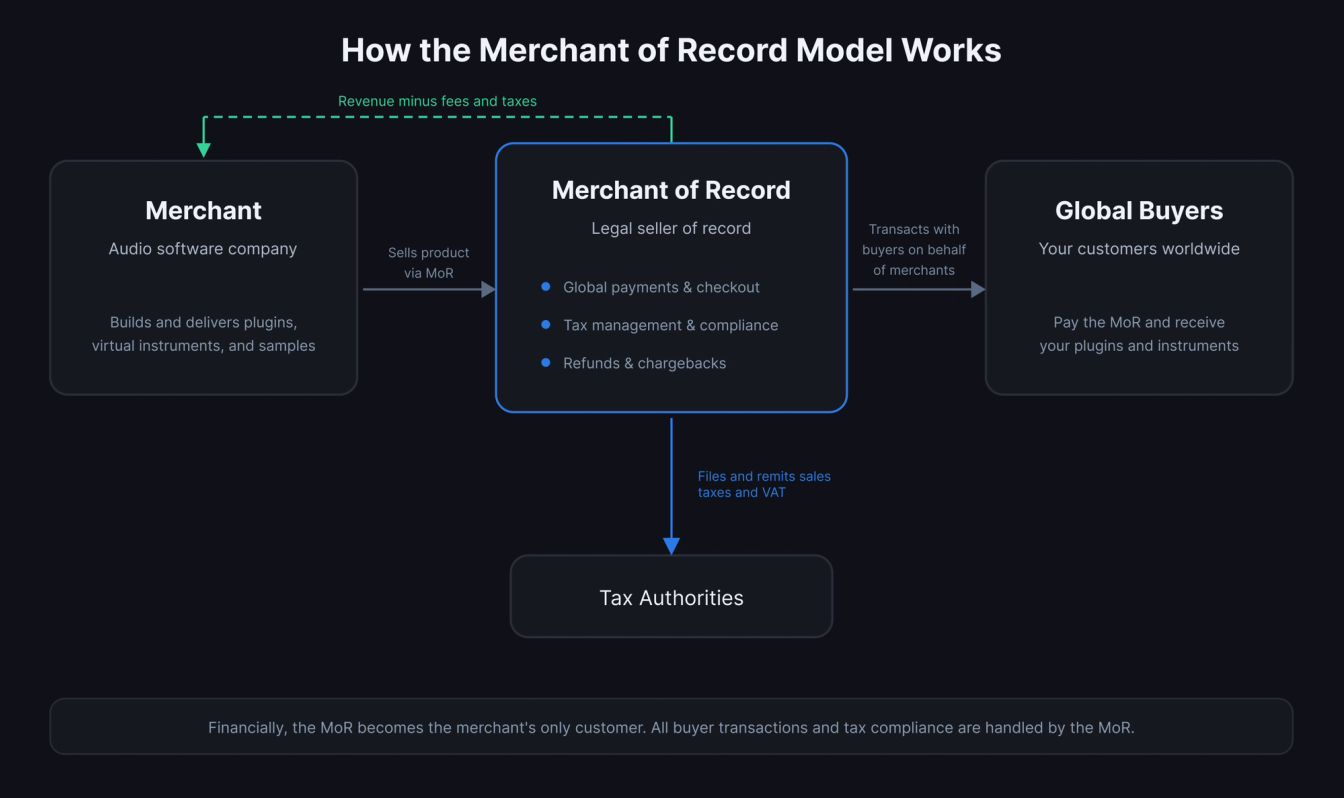
When a customer buys your plugin, they're technically purchasing from the merchant of record, who then has a commercial agreement with you to fulfill that sale. From a tax and legal standpoint, the merchant of record is your only customer, and they handle the entire consumer relationship for tax purposes.
This means:
- They determine the correct tax rate for each transaction based on the customer's location
- They collect and pay all taxes
- They maintain registrations in every relevant country
- They file all tax returns
- They handle all correspondence with tax authorities
- Most importantly: they take on the legal responsibility for tax compliance
From your perspective, you receive a clean payout with all taxes already handled. You're not filing foreign tax returns, tracking threshold dates, or worrying about compliance deadlines in dozens of countries.
If your current setup is Shopify, WooCommerce, or a direct Stripe integration, Moonbase is worth looking at. Not because it's a payments tool, but because it's built around the workflows audio software companies actually have.
With Moonbase, you're solving more than tax. Moonbase handles licensing, affiliate revenue sharing, and syncs enriched customer data to your marketing tools. It integrates directly via a JUCE module, with rent-to-own pricing and iLok integration under development. You're not stitching together vendors or building infrastructure yourself.
The Bottom Line
Tax compliance for cross-border digital sales is complex, and it's getting more scrutinized every year. Tax authorities now have three years of seller data from DAC7 reports, and the infrastructure for cross-border enforcement exists in ways it never did before 2024. Every month you wait, your potential debt grows.
If you're planning to grow, planning to sell, or just want to build a legitimate business without accumulated tax debt, now is the time to get compliant.
Getting compliant isn't a one-time fix—but once it's handled, it stays handled. You stop accumulating debt and start selling globally without the legal exposure sitting in the background.
Upgrade your business
Ready to get started?
Set up your storefront, licensing, and payments in one place. No duct tape required.