Friday, May 15, 2026
Inside the 2025 State of the Independent Audio Plugin Companies report

Hampus Åström
Moonbase Founder
Hampus is financial founder of Moonbase, making sure we are working safely as a merchant of record all around the world.
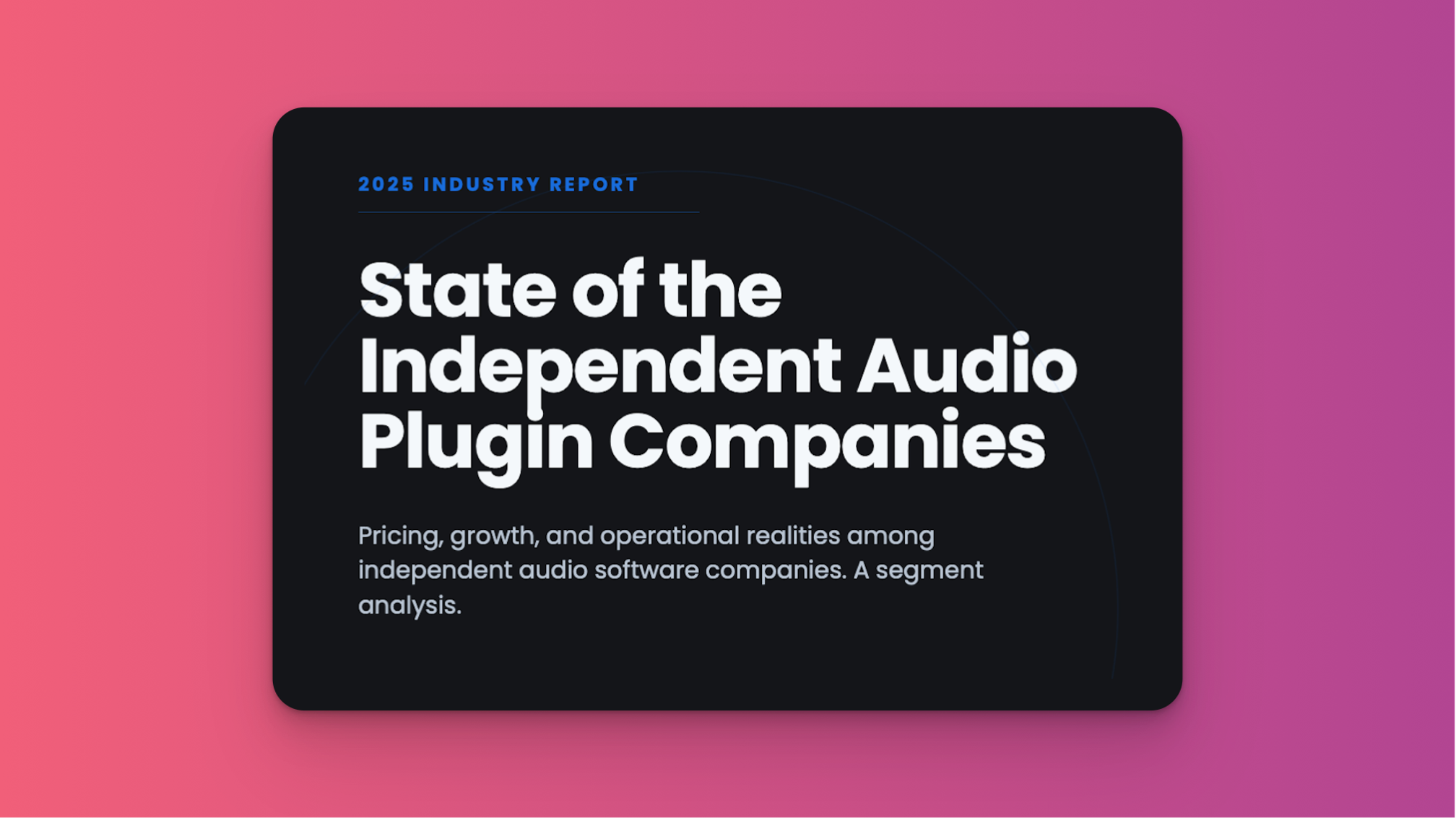
There is plenty of data on the audio plugin business if you look at the largest companies. Streams, royalties, plugin chart positions, public revenue. There is almost none on the rest of the industry — the solo developers and small teams that make up the long tail of the market.
So we asked. In 2025, 95 independent audio software companies answered a survey about how they actually run their businesses: pricing, growth, support load, hiring, and the parts of running a software company that nobody publishes numbers about.
The full PDF is now available. This post is a guided tour of what we found.
Three markets, not one
The first thing the data made obvious: "independent audio software company" is not a single category. The respondents split cleanly into three segments by annual revenue, and almost every interesting answer in the report differs by which segment a company is in.
- 49% Side-Project: under $20K/year. Mostly solo, often part-time.
- 21% Independent: $20K–$100K/year. Usually solo or 2–4 people, full-time.
- 30% Established: $100K+/year. Often a small team, sometimes a single very experienced operator.
We treat these three as distinct markets throughout the report, because the data forces us to. The Side-Project tier does not sell to the same customers as the Established tier, and the things that worry each segment look nothing alike.
Pricing pressure depends on who you ask
49% of all respondents say prices in the industry are falling. That number hides the real story:
- 71% of $100K+ companies say prices are falling.
- 30% of sub-$20K companies say the same.
Pessimism about pricing scales almost linearly with revenue. The companies most exposed to the market are also the most convinced it is getting harder.
What companies actually do about it
When asked about top growth initiatives, 84% cite new products. 2% cite changes to pricing or monetization, despite the pricing anxiety above. The industry's response to a softening market is to ship more plugins, not to reprice or repackage what already exists.
The operational reality
The single largest source of support load is not bugs and not feature requests. It is getting the software installed and activated:
- 29% of support mentions are about licensing.
- 22% are about installation.
- 51% combined: the largest single category of support load by a wide margin.
This is the finding that surprised us least and bothered us most. Half of every founder's support inbox is people trying to get the product running.
Confidence and the veteran's dilemma
The most experienced operators are the least optimistic. 0% of veterans (5+ years in the industry) expect growth above 50% in the next twelve months. 30% of newcomers do. The longer you have been doing this, the more conservative your forecast.
How we did it
- 95 respondents, fielded in 2025
- Geography: 64% Europe, 26% North America, 6% Asia, 2% South America, 1% Africa
- Team size: 64% solo, 26% 2–4 people, 21% teams of 5+
- Distributed through our network and to a handful of independent audio developer communities
- Self-selected sample; sample sizes per segment range from roughly 15 to 72, and are cited on every chart
There are real limitations: self-selection bias, small segment samples for the middle and upper tiers, a European skew. The report is explicit about all of these. We treat smaller segments as directional signals, not precise measurements.
What we want this to do
Two things, mostly:
- Give independent developers some external context for the decisions they are making. The data should help you see whether what feels hard in your business is unusual or industry-wide.
- Start a real conversation about the parts of running an audio software company that nobody publishes numbers about.
We plan to run this survey again next year. If you operate in this market and want to be included next time, let us know.
Get the full report
24 pages, nine sections, every chart annotated with sample size. Read the report.
Upgrade your business
Ready to get started?
Set up your storefront, licensing, and payments in one place. No duct tape required.